Saturday, November 15, 2014

First anniversary of Tamilnadu Music and Fine Arts University (14/11/14)

Anniversary function presided over by Madam Vice-Chancellor, Dr.Prof.Chandrakantha Jeyabalan. Chief Guest:- Director Bala.

Saturday, June 28, 2014

Admissions open!

Tamil Nadu Music and Fine Arts University: admissions open

The Tamil Nadu Music and Fine Arts University was established on 14.11.2013 by the Government of Tamil Nadu and the Chief Minister is the 1st Chancellor of this University and 'Veena' E Gayathri is its Vice-chancellor.
The University introduces postgraduate courses in Vocal, Veena, Violin, Mridangam, Thavil, Nadaswaram, Flute, Bharathanatyam and Postgraduate Diploma Course in Digital Photography and Visual Communication from the academic year 2014-2015.
The University is presently located in the campus of the Tamil Nadu Government Music College, Dr.DGS Dinakaran Salai, Chennai-600 028.
The University will offer Postgraduate courses as mentioned below:-

Department Course
Department of Vocal

M.A. Music – Branch I Vocal

Department of String Instruments
M.A. Music – Branch II Veena
M.A. Music -  Branch III Violin

Department of Wind Instruments
M.A. Music – Branch VI Flute
M.A. Music – Branch VII Nadaswaram

Department of Percussion
M.A. Music – IV – Mridangam
M.A. Music – VIII Thavil

Department of Dance
M.A. Music – Branch V - Bharathanatyam

Department of Fine Arts Postgraduate Diploma in Digital Photography and Visual Communication

The Postgraduate Diploma course in Digital Photography and Visual Communication has been designed keeping in mind the aspirations of the younger generation.
The course content includes Papers in Visual Design teaching basics of graphic design, drawing, Multimedia teaching 2D and 3D animation, photoshop, web design and other modern tools in sound recording and processing, Digital Photography teaching Photographic techniques, lights and lighting, photo journalism, and more. Besides, this course has also been included to the list of elective subjects for the Postgraduate courses offered by this University.

The affiliated colleges and recognised institutions would offer following courses:

BFA in Ceramic Design, Painting, Sculpture, Textile Design, Visual Communication and Print Making in Government Fine Arts College, Chennai.

BFA in Ceramic Design, Painting, Sculpture, Textile Design and Visual Communication in Government Fine Arts College, Kumbakonam

B Tech in Traditional Architecture, BFA in Traditional Drawing and Painting, BFA in Traditional Sculpture to be offered by the Government College of Architecture and Sculpture,  Mamallapuram

Five Year Integrated Graduate Course in Music and Dance at the Kalaikaviri College of Fine Arts, Trichy

Certificate courses in Music with branches in Vocal, Veena, Violin, Nadaswaram, Flute, Mridangam, Thavil and Bharathanatyam, Ghatam, Ghanjira, Morsing to be offered by the Tamil Nadu Government Music Colleges, Madurai and Chennai.

Diploma courses in Music with branches in Vocal, Veena, Violin, Nadaswaram, Flute, Mridangam, Thavil and Bharathanatyam, Ghatam, Ghanjira, Morsing to be offered by the Tamil Nadu Government Music Colleges, Thiruvaiyaru, Coimbatore, Madurai and Chennai.

B.A. and M.A. degree courses in Music with branches in Vocal, Veena, Violin to be offered by the Tamil Nadu Government Music Colleges at Thiruvaiyaru.

B.A. degree course in Music with branches in Vocal, Veena, Violin to be offered in Tamil Nadu Government Music Colleges at Chennai, Coimbatore and Madurai.
For more details, visit www.tnmfau.in

Friday, May 16, 2014

STUNNING VICTORY!

                 Her Excellency Chancellor, Tamilnadu Music and Fine Arts University/The Honourable Chief Minister of Tamilnadu.

 Leading the path towards Peace, Prosperity and Progress!! HEARTY CONGRATULATIONS!!!

Thursday, January 30, 2014

Tantra in daily life ( Part 13)

People have talked so much about raga therapy, nobody so far has talked about "sahithya therapy"!
 Just pick out the most beneficial ( to attain cherished goals/dreams and for addressing problems of any nature) stanza or a two from any krithi and improvise musically ( neraval) in first and second speeds.
To enhance beauty, attraction and virtues:- "Koti manmadha roopude sathguna sagara chandrude..." (Charanam of "Satileni...."Poorikalyani, misra chaapu, Ponnaiah Pillai.
To destroy enemies and protect oneself:-"Ravana Madhanam Rakshitha Bhuvanam........"(Charanam of Bhajare Manasa, Abheri, Adi, Mysore Vasudevachar).
To attain grace of Mother, Father, Guru and God:- "Thalli thandri guru deivamu neevani" (Charanam of Valli Nayakane, Shanmukhapriya, Adi, Muthaiah Bhagavathar).
To get rid of undesirable and bad company:- "Hiranmayeem Lakshmeem sada bhajami, heena maanavaashrayam thyajami..."(Pallavi of Hiranmayeem Lakshmeem, Lalitha, Rupakam, Muthuswami Dikshithar).
To achieve a goal:-"Saadhinchane O Manasa..." (Pallavi of Saadhinchane O Manasa, Pancharathnam in Arabhi, Adi, Thyagaraja Swami).
Repentance and seeking God's forgivance:- "Dudukugala..."(Pallavi of Dudukugala, Pancharathnam in Gowla, Adi, Thyagaraja Swami.
To discover or retrieve lost person or a cherished belonging:- "Kanugontini....."(Pallavi of Kanugontini, Bilahari, Adi, Thyagaraja Swami).
a)For beauty and grace, all krithis of Goddess Tripura Sundari, b)for valour and integrity krithis of Lord Rama, c)for attracting crowds krithis of Lord Krishna, d)for attracting wealth and prosperity, krithis of Goddess Lakshmi, e)for academic achievements krithis of Goddess Saraswathi...........


Saturday, August 10, 2013

Pristine Pure

UNKNOWN FACTS ABOUT VEENA-

The gap between the main four strings (first string: sarani, second string : panchamam, third string : mandaram, fourth string: anumandaram) and the frets of the veena plays a prime role in determining the tonal volume of the veena. The maximum gap between the veena's main string (sarani or shadjamam) and the frets is reportedly somewhere between a quarter inch (0.25 inches) to half an inch (1.27 centimeters), while the minimum gap between the main string and the frets is one eighth (0.125 inches) or slightly lesser than that.
Veena with less gap between main string and frets is used for easy and fast rendering. The strings of such a veena (where the gap between the main string and the frets is lesser than the prescribed quarter to half an inch) are made audible through powerful contact mikes/ digital mixers and other latest microphones. By using an adept mike system it is possible to project a veena with lesser distance between the main string and the frets as a veena with a wider gap between the main string and the frets.
The true nature of a veena is determined only without the usage of microphone. Original resonance, purity and ojas of a veena could be gauged only when the veena is mikeless.
The resonance is strong and deep when the gap is the prescribed quarter to half an inch between the main string and the veena frets. When the prescribed gap is reduced to somewhere between one eighth or around that, the tone becomes feebler and weaker. A quarter to half an inch gap between the main string and the frets demands stamina in the player, even more in the case of gamaka-laden style or bani. Yogic playing of the veena with the recommended distance between the main string and the frets yield tremendous fruits. The player is able to progress through various yogic stages such as dhyana, dharana and samadhi. The player, through indefatigable and rigorous practice is able to attain "vairagya" (detachment) from worldly affairs and finally "kaivalya" (liberation of soul). Soulful rendering, thereby invoking the inner voice through the veena is also made possible in a veena having the prescribed gap between main string and frets. Ofcourse, the purity of jackfruit wood and correct seasoning of the wood are major contributors.
It is also amazing that the place where the jackfruit tree is grown contributes to the nature of the veena. If the jackfruit tree is situated around a temple area or in a nice garden with positive vibrations, the veena made out of the wood of such a tree would yield great spiritual and health benefits ( such as  lustrous complexion, thick hair growth and great energy which is nothing but OJAS) to its player.
When a veena is made out of a  jackfruit tree which is situated around a graveyard or any area with negative vibes, or close to decaying shrubs, contaminated ponds etc.  it will certainly cause bad results in its player. The health of the player would deteriorate resulting in a pale countenance, weakness in limbs, or the player could encounter even worse health problems.
While the player could become famous and prosperous by playing the correct veena (made of good, seasoned wood) he/she would encounter problems by playing the wrong veena (made of bad unseasoned wood). Many a time veenas are made out of venteak or wood essentially used to make furniture (second or third quality teak or rosewood).
For a player to be influenced by the veena he or she is handling, it takes long hours of dedicated and involved practice in an erect posture ( with an erect spinal chord) and breath retention. The practitioner's mere employment of hands to play the veena fails to tap the divine potency of the vedic instrument.
Making of this divine instrument or seasoning its wood on auspicious days or thithis such as pournami, dashami, ekadashi, dwadashi, pradosham, panchami, sapthami and on days when constellations belonging to Devaganas are spiritually significant for invoking the divinity of the instrument.
A veena made out of all the good things as mentioned above is pristine pure and a practitioner who plays such a veena is matchless in his/her worldly and spiritual possessions.


Saturday, July 13, 2013

Lake Shrine, Santa Monica


The ashram of Pujyasri Paramahamsa Yogananda near Santa Monica. After a memorable drive from San Diego, via Santa Monica to Malibu to visit the Balaji Temple and back to San Diego via Lake Shrine, situated close to Santa Monica.......

Friday, July 12, 2013

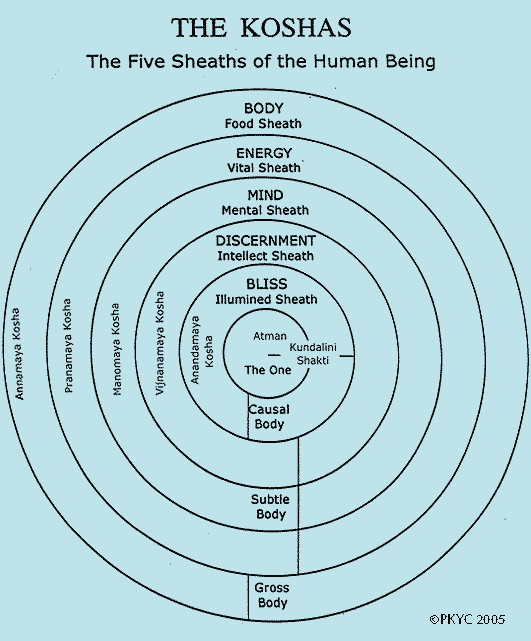
Subtle body.... a foreign view....

"In the terminology of certain Eastern teachings the first body is the 'carriage'
(body), the second body is the 'horse' (feelings, desires), the third the 'driver' (mind),
and the fourth the 'master' (I, consciousness, will).
"Such comparisons and parallels may be found in most systems and teachings
which recognize something more in man than the physical body. But almost all these
teachings, while repeating in a more or less familiar form the definitions and divisions
of the ancient teaching, have forgotten or omitted its most important feature, which is:
that man is not born with the finer bodies, and that they can only be artificially
cultivated in him provided favorable conditions both internal and external are present.
"The 'astral body' is not an indispensable implement for man. It is a great luxury
which only a few can afford. A man can live quite well without an 'astral body.' His
physical body possesses all the functions necessary for life. A man without 'astral
body' may even produce the impression of being a very intellectual or even spiritual
man, and may deceive not only others but also himself." A famous Russian philosopher.

Sunday, May 26, 2013

Radhe Radhe..

Goddess Radha's star, Jyeshta (today's star as I am posting this) means "elder" which is probably an indication of Her being many years older than Lord Krishna. Their relationship surpasses human concepts and is essentially spiritual in nature.
The "sama sapthama bhavam"in the horoscopes of Lord Krishna and Goddess Radha (Lord Krishna's star Rohini in Taurus and Goddess Radha's star Jyeshta in Scorpio forming a mutual aspect)is another indication of their supreme compatibility. ( my search for the horoscope of Goddess Radha continues for deeper insight......) A mutual aspect between boy's and girl's moons in their respective horoscopes eradicates every other disagreement under rajju, vedha, gana, rasi etc. of the charts.
Sage Durvasa, who worshipped Goddess Kamakshi (author of "Sowbhagya Chinthamani Kalpa" a divine text about the worship of Goddess Kamakshi) is believed to have presented a boon to Goddess Radha.
On a Dwadasi thithi while Radha was playing with her friends, the Gopis, Sage Durvasa arrived at the palace of Radha's father, King Vrishabhanu. All the gopis ran away at the sight of the angry sage, but Radha remained. Durvasa muni was immensely pleased to see the incomparable beauty of Radha and asked her to feed him sweet rice prepared with her own hands.
Radha immediately ran to Her mother to collect the ingredients: nicely scented rice, milk, sugar, raisins, almonds, cashew nuts, elaichi, camphor etc.
The sweet rice Radha prepared out of the ingredients turned out to be inconceivably sweet and delicious beyond belief. The nectarean rice Sage Durvasa ate while Radha served convinced him that Radha was none other than Goloka Mahalakshmi, no one else could have made such a wondrous preparation that defeated the taste of nectar and caused him to experience ecstasy.
Sage Durvasa, pleased with Her service and out of affection for Her announced,"I am offering You a boon that whatever Your hands touch, whatever You prepare, will taste better than nectar. Whoever tastes this food cooked by You will have long life, strength, beauty and fame, all of which will increase day by day!"
On hearing about Sage Durvasa's boon, Lord Krishna's mother Yashoda Devi requested Radha to cook for Lord Krishna so that He would benefit from Sage Durvasa's boon.
Goddess Radha went to their house to cook for Lord Krishna and His mother, Yashoda Devi so that She would have so many chances to see and meet with Lord Krishna!

Tuesday, January 8, 2013

The Ultimate Music

The inner music has a strange quality. The outer music needs an instrument, it needs a duality-the musician and the instrument. The inner music does not need duality- the musician is the music, the musician is the instrument, the musician is all. There is no division. The inner music means silence, the sound of silence.
Silence has its own music. It can be heard only by those who have dropped all noise from the head. It can be heard only from the heart, not by the head. The heady person goes on missing it. Only the person who is full of heart, full of love, can hear the music.
This is the music that helps you to go beyond. It becomes a rainbow bridge. You cannot grasp it with the mind, you cannot comprehend it with the mind. The mind has to be put aside, completely put aside, and then suddenly it is there.
That is the whole art of meditation, putting the mind slowly aside and getting to the inner music, becoming attuned to the inner world of oneness. You can call it the experience of God, Tao, Truth, Dhamma; it is really nothing but the experience of the ultimate music-OSHO.

FEATURED POST

KANYAKUMARI FOR SPINAL ALIGNMENT

                                                            GODDESS KANYAKUMARI The convergence of 3 oceans ( the Triveni Sangamam of Bay of...